Exciting Bitx40 Modifications

Make your Bitx40 Work FT-8 & WSPR!


Happy New Year ~ 2020!

[The following describes two methods for adding USB capabilities to your Bitx40 and further adds an alternative to the Raduino controller.]


So OK I built my first Bitx20 shortly after VU2ESE announced to the world his exciting project -- that was over 10 years ago. Even then W6JFR (now N6QW) hacked that project by converting the inductors to ferrite core, shifting the IF to 9 MHz and adding an LCD Display complete with a EI9GQ VFO stabilizer.


So it goes to reason that I would still be hacking this amazing design --today! Bill N2CQR provided two "seed" Bitx40 boards and I am happy to report that both boards have now been "hacked" so that they are USB capable and working the 40 Meter Digital Modes such as WSPR and FT-8. 


But here is the icing on the cake the hacks involve two completely different approaches and this experimentation has provided some new ideas for me for use on other rigs.


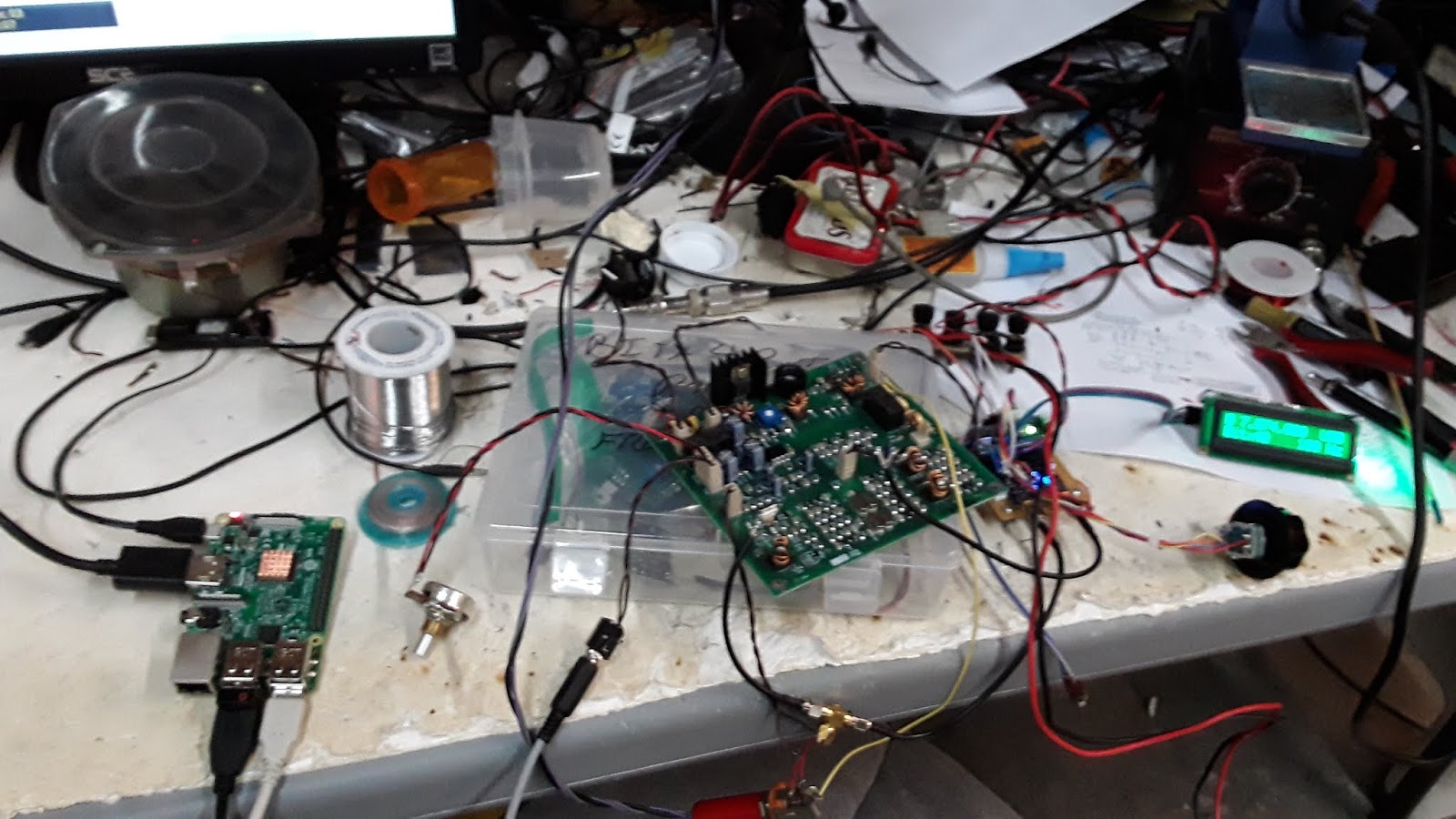
  1. The first hack was to design a controller other than the Raduino. You see I got two Bitx40 boards from Bill and only one Raduino --which doesn't work. I now have a working controller which has been expanded into two working controllers to support the two boards. They are not identical...

  2. The first approach was to create two BFO frequencies (Upper and Lower Sideband) using the 5 MHz LO so that you could select USB or LSB. Much experimentation was required to find these two frequencies. That done we added two VFO's in the code and also a TUNE Tone. That rig has been in operation for several weeks using WSPR and FT-8. A bit of history here -- not all Bitx40's are standard as there are as many as three variants depending on the crystal sorting process and the Center Frequency of the 4 pole filter. So be aware --not all is plug and play. You will have to find the Cf and BFO frequency of your particular Bitx40. This mode involved unsoldering one end of L5 and applying the BFO signal through a 10NF Capacitor which is fitted to the base of Q10.  
  3. So now to the second Bitx40 board -- here the BFO frequency is actually about 400 Hz higher so you have to account for that in the code. This also means that the Filter Center Frequency is different! In the  SolderSmoke Podcast #216, Bill described his adventures with digging into the innards of a uBitx. One comment just sort of passed through my head and it wasn't until I was listening to #216 on my morning walk -- I had a Shazam Moment. Boom another way to do it. Bill mentioned that the uBitx being dual conversion used a technique to place a conversion oscillator with either the clock above 45 MHz by an amount of the IF or below 45 MHz by the same value of the IF. 
  4. There it was... The Normal LO of the Bitx40 is in the 5 MHz range and with a 12 MHz IF a mixing process puts the display at 7 MHz and LSB. Now suppose you put the LO at 19 MHz and down mixed so LO - IF now gives the Display at 7 MHz but with sideband inversion and USB. Boom it works; but more must be done to have it work on the Bitx40 board. Read ON!
  5. The code has to be modified so that for LSB you have a term that is software selected such that ( bfo - rx ) will result with the 5 MHz LO (rx). But when you change to the 19 MHz LO (rx) a new term must be called up in the software so that you now have (rx - bfo). This also causes in one case a CW rotation of the encoder makes the display go higher in frequency. When you switch to the other LO then it is a CCW rotation that will make the display go higher. For those who cannot take this quirk the LO select switch instead of a simple SPST could be a DPST switch where the 2nd half controls a small DPDT relay to reverse pins D2 and D3 so that it will always be CW increases the LCD reading. So for those of you who have trouble seeing this arrangement.
    In essence we have a cross connected DPDT relay that when not energized connects the D2,D3 pins on the Arduino to the Rotary Encoder. Upon being energized the D2, D3 pins are now switched to the opposite direction from the former state. the Encoder will now tune in the same direction for either LO. The triggering circuit would be to have a spare Arduino Pin go HIGH which would drive the base (through a 1K resistor) of a 2N3904 wired to the field coil of the relay. This would mean keeping the USB LSB Select to just the single SPST switch.
  6. There are those who would maintain that juggling the software could do the same thing -- well friends a hardware solution like this is simple to accomplish and you will not spend countless hours debugging software. When you know stuff you can do stuff. 
  7. So I rewrote the code such that with one position of a SPST switch you have the 5 MHz LO and LSB which is displayed on the LCD. The engagement of the switch shifts the LO to 19 MHz AND changes the math so that the BFO frequency is now subtracted in this case and the LCD reads USB. A further refinement would be to have the USB Boot Up be at 7.074 MHz, which is a simple code change.


  • I then loaded the software and connected my controller to the Bitx40 where now the original BFO crystal is retained and works for either USB or LSB. I simply plugged Clock 0 into the two pin port and fired it up. All worked well for LSB and the sound is really crisp and I have indeed installed the correct offset -- the sound is on the mark and the frequency is on the mark!


    A switch over to USB and while signals were heard -- they were weak, very weak. Hmmm my new theory has been shot to hell! 


    It is always best to put things aside and "noodle" over what happened. The frequency scheme does work (super good for LSB); but marginal for USB. I printed out the schematic for the LO injection and saw (after sleeping on it) a possible reason for the USB issue. 

    In the original Bitx40 the frequency control was by means of a varactor tuned VFO which shortly was replaced by the Raduino. Essentially the varactor tuned VFO is a Colpitts Oscillator and in place of the tuning network the Raduino is installed. There are a couple of very Large caps -- 1000 PF in the Colpitts circuit that work OK at 5 MHz but when you place a 19 MHz signal in there -- closer to a short circuit! If you do the math assuming  a 500 PF load at 5 MHz the load is 63 Ohms and at 19.2 MHz the load is 16 Ohms. So it must be a loading issue. (Two 1000 PF is series = 500 PF)

    So my first thought was to bypass the Colpitts oscillator transistor and introduce the LO beyond that stage. Boom -- when you know stuff you can do stuff!

    That did the trick and the above schematic shows the where to inject the signal. We now have a way to add LSB and USB to the Bitx40 while retaining the same BFO Crystal. Listen to the SolderSmoke Podcast #216 and you will hear me discuss how Ten Tec did a similar trick to use one BFO crystal.

    There is a bonus here in that you even end up with two VFO's and the memory function holds.


    So dig out that Bitx40 and put it on FT-8. If you email me at craponthebench@gmail.com, I will be happy to send you both sets of code.

    Here is the 2nd Bitx40 on WSPR today:
    That is Europe, Africa and South Africa! The Modification definitely works. Pout = 5 watts! The antenna is an inverted V with an apex of 35 Feet. 

    Caveat Emptor -- there are three different BFO frequencies used with the Bitx40 so you might have to "diddle" a bit to, get yours to work. If you don't know how to do that --don't even start my modification!

    73's & Happy New Year
    Pete N6QW


    The Whaddon Mk VII - Paraset Clandestine Radio

    What is a Paraset?


    12-12-2019 40 Meters is wide open!


    This is just the transmit part of my Bitx40 using my N6QW Controller. First time to be heard in the Philippines and Singapore from this QTH. Maybe this could be done with a Paraset?

    20 minutes later --really open. (Transmit only)


    Yes haywire and chewing gum; but can also do FT-8.  *****************************************************

    No I didn't say parasite but Paraset! 

    Bottom Line the Paraset was a clandestine radio set built in England and supplied to agents operating behind enemy lines in the European theater during WWII. Most went to the French Resistance; but some found their way into the Scandinavian countries. 


    It is believed that Torstein Raaby, the radio operator on the Kon Tiki voyage used the Paraset while a Resistance Fighter in Norway during WWII.


    The whole radio was stuffed inside an innocuous looking scruffy suitcase. The standard issued radio even included some spare tubes right in the case.


    What is up here?


    At first I thought it would be nuts to rely on such a radio as your primary communications link with your headquarters. Then I forgot that the British had 10,000 National HRO Receivers parked about 100 miles away whose only job was to copy your signal and at the same time some very powerful radio stations sending RF in the other direction. So perhaps when the whole system is evaluated not all bad.

    It was quite an interesting radio receiver / transmitter that I previously mentioned was stuffed into a small suitcase so that it would be disguised. 

    There were several options for powering this rig including from the mains as well as from a DC power pack (vibrator supply). 

    The basic scheme was a two tube (6SK7's) regenerative receiver and a one tube (6V6) CW transmitter crystal controlled operating in the 3 to 8 MHz range. The receiver tuned the same range. The power output of the transmitter was at best about 5 watts. Keep in mind friend Bill, N2CQR has made 20 contacts on 40 Meters running a one transistor regen and one transistor transmitter at 100 Milli-watts. Some DX is like 1000 miles away --so 100 miles with 5 watts is a cake walk!

    The transmitter tuning used a two light bulb system (Load & Tune) for indicating maximum RF Juice to the antenna. For antennas don't think of 40 Meter dipoles strung between two trees at 100 feet. Often a chunk of wire was thrown on the floor or perhaps strung around a room.

    Many hams world wide have taken up the challenge to replicate this amazing radio and the internet abounds with many replica examples of the Paraset.

    I tried my hand at building just the transmitter section and found it to be somewhat underwhelming. I also did some preliminary work on the Dial Drive Mechanism which was friction drive controlling the main receiver tuning capacitor


    73's
    Pete N6QW


    Bitx40: ~ Replacing the Raduino with the N6QW controller!

    Say What: Replacing the Bitx40 Raduino?

    12-07-2019 ~ Pearl Harbor Day

    Let us not forget what happened 78 years ago today. On a sad note there are but three remaining survivors of the original USS Arizona crew and only one will be attending the commemoration ceremony.


    Many have sacrificed to make this the Land of the Free and the Home of the Brave! 

    *****


    I have now added switching of an linear amplifier to the PTT circuit so I can run 600 Watts with my "reworked" Bitx40.  Two 1N4148 diodes and a 12 VDC SPST relay make it all happen. Running a bit more power does help.

    My latest project now on my website...

    http://www.n6qw.com/The_Paesano.html


    12-04-2019:


    I call my Bitx40 "Maggie May" since she has been passed around a bit and before transmitting I specifically looked at the Bitx40 documentation. Shazam -- The bias was at Zero and not set to 100 Ma, and there was no drive as such. Fixing those two provided 10 Watts of solid power output on 40M. I cranked it back a bit since it would see some heavy duty cycle operation on WSPR. 

    My offer stands: any one wanting to dump their Bitx40 -- a crisp $10 Bill and shipping costs from a US address is my offer. C'mon guys rid yourself of that former play toy and let N6QW work his magic. 

    Send me an email to the address on the masthead if you would like the sketch code. 

    N6QW, Pete the Radio Genius


    12-03-2019 ~ Digital Modes with the Bitx40 and the N6QW Controller.


    Raspberry Pi3 and (not seen) N6QW Digi Controller being used with the Bitx40 and N6QW's Raduino Replacement.

    A couple of key comments 


    1. This shows I must be close on the USB offset as both FT-8 and the WSPR were dialed in on their normal frequencies
    2. I did not transmit on either WSPR or FT-8 as you must modify the Bitx40 Microphone input circuit. The Bitx40 uses an electret microphone which typically has a DC bias voltage on the input pin. As I did on The Paesano, I added a Data Port -which is nothing more than a 3.5 mm stereo jack that has a 10 NF cap in series with the microphone port to provide DC Isolation. That has yet to be done. Works perfectly on transmit see last chart.
    3. So for those of you who have "put away" your Bitx40, with a few changes you can do "The Digi Dance" with your rig.
    4. My offer is still open if you would like to dump your Bitx40 -- a crisp $10 bill plus shipping and I will take it off your hands.
    5. WSPR on the Bitx40 with N6QW Arduino Controller.

    6. After three hours both transmitting and receiving


    The Bitx40 being heard In Brazil and Sout Africa! Nice!

    Stay tuned to this space for more exciting Bitx40 Modifications -- may be even 6 Meter SSB.


    Pete, Radio Genius


    73's

    Pete N6QW


    12-02-2019

    Is this like blasphemy, heresy or on par with the Ukrainian Bribery scandal? No, it is none of those just a practical matter. 

    In a recent Soldersmoke Podcast #215 the fact was made known that the Bitx40 was no longer in production. I then said if anyone wants to sell me one for about $10 contact me. That offer is still on the table!

    Well my good friend N2CQR sent me one that had been passed around a bit (you know like Maggie May and the high school football team). Well when I connected all I soon discovered that Raduino was not providing any RF. The pot tuning also left me wondering even if it did work would I be happy.

    So I took some parts, took some software and when you know stuff you can do stuff!

    I started 1st with a 5 MHz PTO from a Drake TR-7 and that was to quickly establish that the main circuit board worked and was the Raduino the only problem. That was accomplished. 

    Next was to get a basic Nano and Si5351 to produce the LO signal which was also to prove that my LO was correct and that a first stab at the BFO frequency was at least in the ball park. Keep in mind that not all Bitx40's are exactly alike. I think initially depending on Uma's crystal sorting there could be as much as 3 BFO frequencies.

    Finally after passing the LO test I added the BFO. This test proved that the LSB BFO is very close but I may need to tweak the USB -- next phase. To introduce the BFO signal (since the LO is done through a two pin header) I had to uncouple the crystal and inject the BFO into the base of the former oscillator transistor. I am using a custom made for Pete Si5351 PLL's that has isolating caps on the outputs built into the board. Your may not so include a 10 NF on your output other wise you may smoke the transistor or your Si5351. Add the BFO signal at the junction of R102, C104.


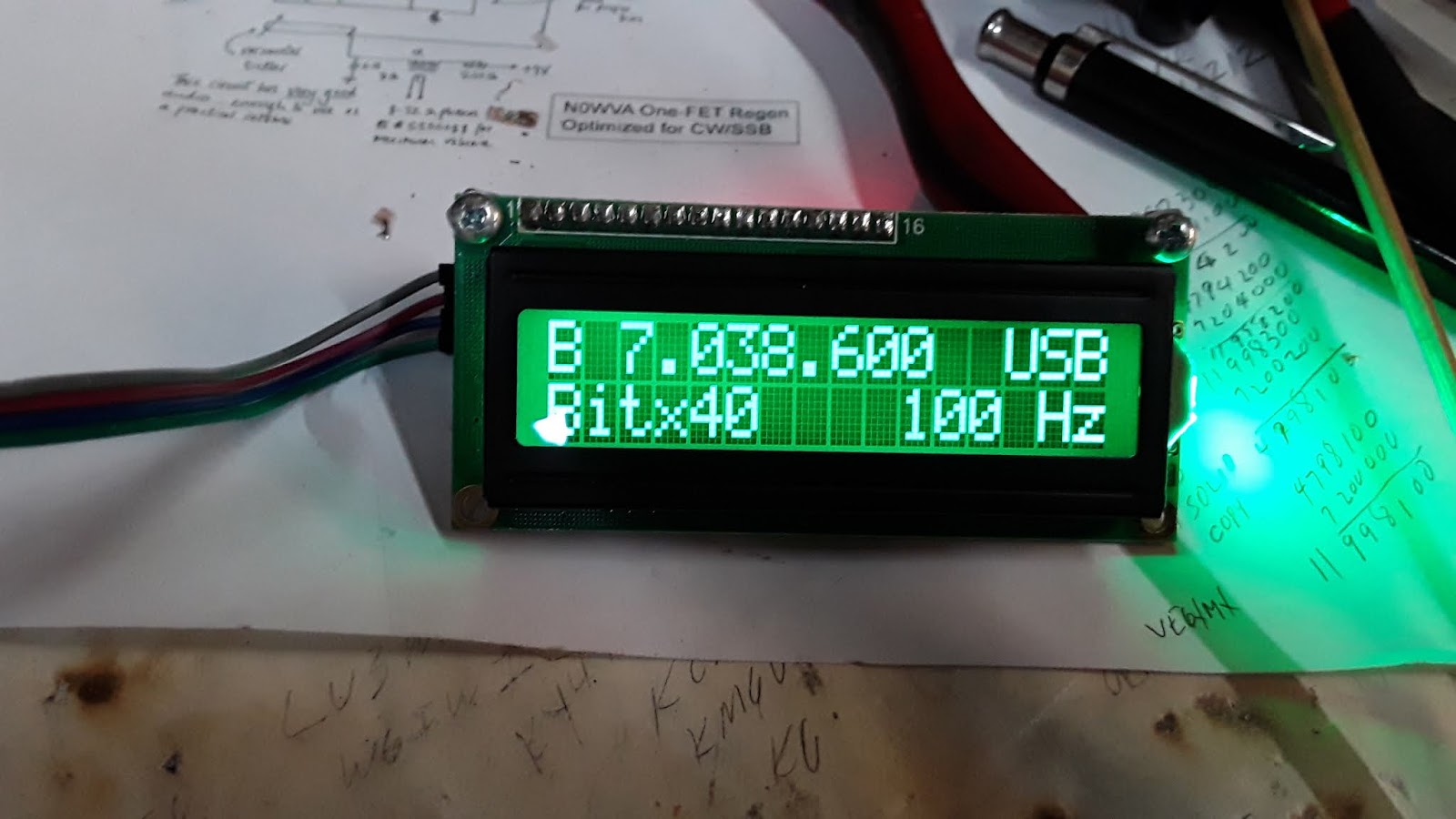
    Recapping my Raduino Replacement has 2 VFO's, USB/LSB and a Tune Tone. Did I mention the cool Green LCD?

    The long term plan is a 6 Meter SSB transceiver using an outboard Transverter. Stay tuned and try to catch up.


    Pete N6QW


    Applying DNA Testing Techniques to Electronic Troubleshooting

    Scrolling through the CNN app this morning, I found an article about DNA testing that was done on Hitler. In a macabre event that acquired a...