The idiom "beating a dead horse" is a common term across the world but what does it mean?
A trip to the internet suggests the following explanation: To waste an effort on something when there is no chance of success.
Those who are Democrats should internalize that phrase and rethink the next four years. That guy has you by the cojones and there is no letting go. The chaos and path of destruction is just starting! Don't get mad but get even by playing smart and laying a foundation for the 2026 and 2028 elections. This approach bypasses trying to do a tit for tat on a daily basis. Besides by being silent and in a stealth mode will raise his paranoia level about the hidden state.
For those with bravado and large cojones who think simply buying four crystals and a handful of 68pF caps and hoping by simply connecting those parts will result in a superb four pole filter you are beating a dead horse.
What exemplifies not beating the dead horse is getting smart and that entails learning. Do some research and get a copy of Solid State Design for the Radio Amateur (SSDRA). This book is chock full of learning!

This publication is far more user friendly and useful than EMRFD for a new homebrewer. A tour through the appendix shows you how to hand calculate a Band Pass Filter. Now that sure is handy. It is chock full of projects covering receivers, transmitters and transceivers. There is a great section on practical homebrew test gear which is low cost and easy to build. It would be my recommendation, if I was charged with only recommending one publication. It is really written to include someone with entry level skills. Regrettably EMRFD is not!
Choosing to go with EMRFD as the only one is like beating a dead horse.
It is an observation of mine that experienced homebrewers always seem to cite their material source as occurred this morning with an email I received. Reference was made to the work of Todd (The Popcorn Blogger, [Vasily]) and Alan who has a prolific stable of you tube videos. Often you will hear Wes, Farhan or Doug as the source. Mere mention of all of these names creates an air of credibility to the subject being discussed. Without question all of these names are the illuminati of the hobby, and they certainly know their potatoes.
This next part to be discussed was in a schematic from Wes in SSDRA for a double balanced frequency mixer circuit that uses the SN56514. So, this next piece is Wes + SSDRA, thus it must be creditable. That particular DBM IC has a changed part number and that is now TL442C. Now that is not a household name but even shows up in a piece of Ten Tec gear.

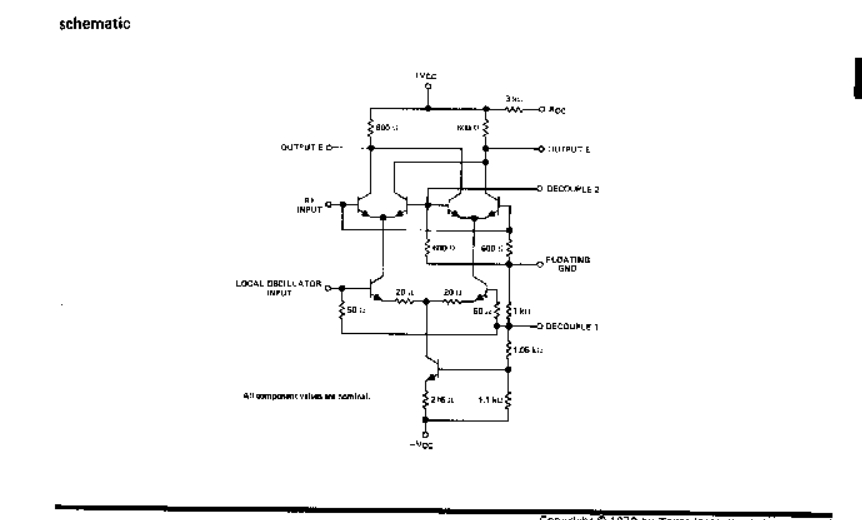
The TL442C specs are not as tight as the MC1496, but the advantage with both IC's is no cores to wind or diodes to match. Regrettably trying to find a TL442C to tinker with is like beating a dead horse. Homebrewing a DBM is like beating a dead horse when you especially have superb tools such as the ADE-1 or MC1496. I personally am more interested in performance.
Them that know can make it go!
BTW SSDRA COSTS MORE TO BUY TODAY, THAN EMFRD AND HAS A HIGHER RATING LIKE 4.8 VERSUS 4.5. That tells the tale!
73's
Pete N6QW


