Monday, July 14, 2025

Arduino to the rescue!

With a bit of certainty, I am led to believe that the VFO in the Project X rig is inoperative. The Malocchio is in effect! Back at You!

Getting the VFO assembly removed from the rig for repair is daunting, but getting the unit back into the rig is an even bigger, almost insurmountable task. The old axiom, when in doubt look to technology for a solution. Enter the Arduino with the Si5351 as the saving heroes.

For some this has Italian roots found in the word "scandalous". While it would be cool to keep it original, it is an Analog VFO that has failed! I have upgraded many commercial radios and long ago faced that decision.

The change over while not in the original plan does upgrade Project X to a rig with finer gradations on the frequency readout while also providing extreme frequency stability over the original which only held a 100 Hz drift for only 10 minutes. 

Since Project X was intended primarily as a SSB rig, the original covered only the phone portions of the bands. We now can use FT-8 with the Digital Electronics.

We also have many choices for the display including LCD, OLED, Color TFT and even the JF3HZB display. 


No, this is not "THE" display, but a very nice hardware display!


Yesterday I whipped up an Arduino LO using an LCD and tested that on one of the bands. It worked surprisingly well and that experiment is tilting and coloring my decision on a R&R action... you know the old Rip Out and Replace parlor trick.


Them that know can make it go.


73's
Pete N6QW

Sunday, July 13, 2025

The Evil Eye ~ In Italian, Malocchio!

With origins in what is today modern-day Iraq, the "evil eye" is a paranormal concept where the simple act of looking at something or someone causes a catastrophic event to happen. The look may be driven by greed, envy or simply being a nasty person. There is a long history surrounding the evil eye and it was so feared that merely telling a person that you were calling up the evil eye caused death in that person


As a kid I remember my maternal grandmother (from Calabria) often talked about the "malocchio". Warding off the evil eye had remedies such as throwing salt over your shoulder or spitting in the wind without getting spit on you. There was even a hand gesture using the 1st and 4th finger to ward off the spell. (Is that a predecessor to the Middle Finger?) 


Project X VFO Transistor

Well, the malocchio hit the Project X transceiver project yesterday as it stopped receiving or transmitting. The problem was traced to the Local Oscillator (VFO) as right in the middle of listening to a QSO it drifted off into silence.

There is a weight of evidence it was the evil eye, perhaps inflicted by a blog reader who does not like my keeping details about the rig as a mystery. But it sure is not a coincidence that yesterday's posting was about the VFO and then mysteriously it stopped working.

I know it is the VFO as I injected an LO signal from my signal generator into the receiver mixer and Boom! She works which also revealed that the LO level as designed was a bit on the low side. Better receiver performance was found with a bit more juice to the Rx Mixer stage.

Keep in mind whoever did that... an evil eye right back at you.

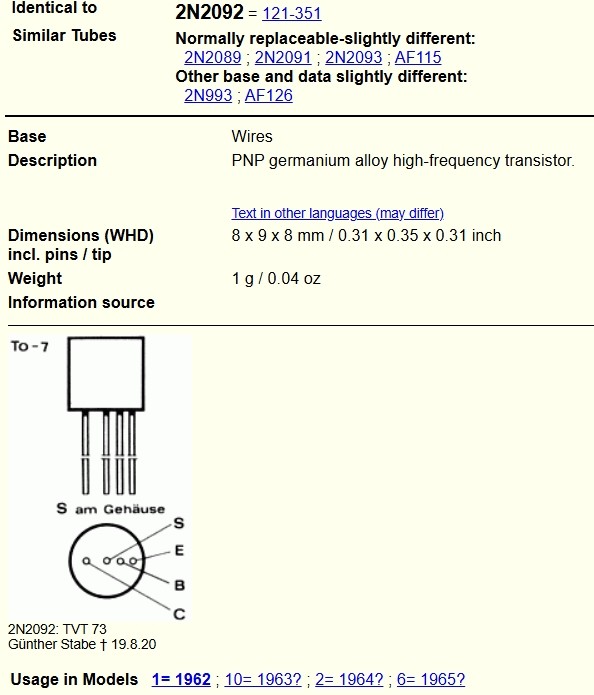
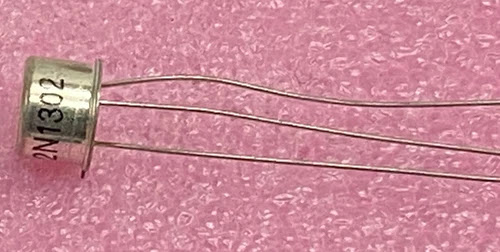
I will get the VFO fixed, and the transistor used in that part of the circuit is shown in the photo as I have 3 spares. The 2N2672 is sub which I also have. But now we have the real problem.

When I worked for a living, I constantly dealt with DFMA, (designed for manufacturing and assembly). Most of the SSB rigs designed during this time had one focus... small, compact and low profile. 

Many were intended for mobile use and if you had a YL in the car it was dangerous to try to tune the rig when the YL's knees were smack dab in the middle of the front panel. Quite obviously she might think you were performing an entirely different action if it were a big box.  So, low profile was always good.

Rig designers of this era paid no attention to DFMA and essentially built the rig around critical assemblies. Thus, any maintenance required major disassembly to access that circuit. That is exactly the case with the Project X rig. I will likely have to remove the front panel and do extensive mechanical and electrical deinstallations just to get to the VFO board.

A friend in the early 1960's bought a Lotus Elan sports car. Imagine his surprise, that to change the oil you had to pull the engine. DFMA!

Them that know can make it go!

73's
Pete N6QW

Saturday, July 12, 2025

ICE Raids on Laguna Rd in Camarillo, CA

Wow! Five miles from my QTH, ICE was busy this past Thursday rounding up some 200 illegal immigrants. The Centroid of this DHS action was Laguna Road in Camarillo, CA.


ICE, note the tear gas masks.

On Fridays I travel over Laguna Road on the way to visit the XYL at the cemetery in Oxnard. This past Friday, yesterday, at about 8 AM, there appeared to be some ICE agents still hiding in the bushes or at least somebody in the bushes on Laguna Road (perhaps a CA reincarnation of Mary Jo vintage 2025). 

This is close to home and scary. Where are we headed... seized and detained because of how you look or that you speak Spanish. What happened to probable cause and due process.

But I do wonder who is feeding DHS, the pinpoint locations of where to use "Roundup". Shades of Russia where it is mandatory that you be a snitch. 

There is a fascinating situation at the intersection of two roads quite near CSU Channel Islands, the purported reference in the Eagles song "Hotel California". Prior to becoming a university this was a state mental hospital. 

Back to the intersection. On one side, one road is called Potrero Road and on the other side it's called Laguna Road. For the other road, one side is Lewis Road, and the other side is Hueneme Road. One intersection and four different road names. That ought to confuse the GPS systems.

The Project X radio is not unlike the Swan 240 or Hallicrafters SR-160 in that the IF is in the 5 MHz range and the LO for 80/20 Meters is in the 9 MHz range and for 40 Meters in the 12 MHz range. The Swan 240 actually has a two range VFO to provide the 9 and 12MHz injection frequencies. The SR-160 uses the same range for all bands except Hallicrafters included a 3.9 MHz crystal oscillator and mixer stage so that you had a 12 MHz output on 40M.

The Project X rig uses the Swan 240 approach only the 40M LO is generated at 1/3 the frequency and that is frequency tripled to provide the 12 MHz LO. Incidentally, the Project X and Swan Monobanders used the same IF filter frequency. 


The 2N2092 transistors are almost unobtanium but a 2N2672 is a good sub having identical specs with the only difference is the Ft is 30 MHz on the 2N2092 and 180 MHz on the 2N2672. The 2N2672's were used in the later SBE-33's and the SBE-34's so many are still floating around the old hulks.

Them that know can make things go.

73's
Pete N6QW

Friday, July 11, 2025

The Mysteries Abound ~ Project X


A Partial Schematic 


All the time you thought I was talking about Ham Fests, Slide Rules and Parts, you likely didn't suspect I was really working on Project X.

Yes, it is receiving and even transmitting (at low levels as the Power Supply is still in work). But that only exposes more mysteries. The Receiver part is in need of a full alignment as some bands work far better than others. The Transmit part will be the head scratcher!


Above is a partial schematic of the Carrier Oscillator and Balanced Modulator. As I describe the problem keep in mind this is also the Product Detector on Receive. This is a very common approach in these circuits of this vintage and even in current rigs (The SBE-33 and SBE-34 and the P3ST). 

The 1st positive note is that it is a diode ring, as opposed to the two diodes often seen like in Bitx radios. It has two balance controls, the 1st being the carrier amplitude via the 500 Ohm pot which also is the injection point of the carrier signal. The second balance is for phase and the 15pF and the 5-18pF trimmer form the basis for that part of the balance. Adjustment of these controls does indeed reduce the carrier level as measured on the secondary of L1.

Typically, when all is nulled the level of carrier (i.e. no modulation) is very small and frequently is 50 dB down from the sideband signals also generated out of the Balanced Modulator... Duh, why do you think it is called a BM. 

So, what would cause a significant level of carrier (like 2 Volts PTP versus signals which should be millivolts). Notionally you would start with the signal level of the BFO. If its level is way too high that is a possibility. I tried detuning L2 to see if that would reduce the carrier level but that did not prove fruitful. 

When you get carrier balance the level drops into the mud. You can see it on a scope, but you can also hear it on a nearby receiver. No question, you will hear the null like it is a whisper versus a booming sound without balance.

The BFO has no provision for adjusting the carrier frequency as a condition could exist where the BFO is smack dab in the middle of the crystal filter pass band and that would pass right through the filter. But this is likely the lowest of the probable causes. Receive sounds OK as that would be another indicator of this possibility.

Another possibility is one or more bad diodes in the diode ring. I have ordered up a batch of 1N5711 Schottky diodes and will replace all of them. Even if it is not a diode having all Schottky didoes in the ring is a good change. It also is scratched off the list should the condition still prevail after the change.

I can look at the transmitted signal at the collector of the final driver transistor and with no modulation you see a "fat band" of carrier output versus what should be a very small trace. With audio applied you see the Christmas tree pattern over the carrier with some nice peaks.

It is clear this is not a one and done project but in fact a long-term opportunity to use my slide rule and tribal knowledge.

Them that know can make things go.

73's
Pete N6QW

Thursday, July 10, 2025

Hamfest Time

It has been literally a hundred years since I went to a Hamfest. I miss the pomp, circumstance and sheer adrenaline rush of finding some item that you thought had disappeared from existence. Summer is in full swing and time to find a Hamfest. For our UK friends the radio rallies are a 1st cousin to the US Hamfest.


One of the best monthly Hamfests here in California was in the parking lot of TRW near LAX. If you didn't start shopping by 6AM, you would miss out on the good stuff. In the 1970's I went to a TRW event arriving prior to 6AM and at the 1st table I found one of those you will never find this ever deals. Some months earlier, I had purchased a used SBE-33 SSB transceiver which was in good shape but did not have the special and very rare DC to AC inverter that was sold to enable mobile operation. There it was and a $20 bill put my SBE-33 in the car operating 20M Mobile. 

Today you could buy a suitable inverter for less than that $2o bill at You know where.


What would I look for at a hamfest today? Regrettably today most hamfest treasures involve a lot of old computer parts and not old-time radio equipment. So here is my list.

Mason jars chock full of transistors as there is a good likelihood of the presence of PNP Germanium RF transistors needed for those early hybrid radios.

Jones Plugs (12 Pin) as these are the standard amongst many manufactures (Drake, Swan) as is the 11 Pin octal type (Heath and Collins). BTW if any blog reader has a 10 Pin socket (rectangular) made by Elco let's talk turkey. Contact me at my QRZ.com email address.

Ceramic slug tuned coils (National and JW Miller) and IF cans. Frequency or inductance not important.

Tubes such as the 6AG7, 5763, 12DQ6, 6DQ5, VR-150 and 7360.

Small aluminum mini boxes from Bud or LMB. Aluminum chassis or chassis kits.

Dynamic microphones (throw the case away and keep the innards).

EOL (End Of List)

But there is a process for going to a hamfest which involves taking only $40 in cash along with a backpack and small pull cart. Keeping the cash stash low causes you to be a deliberative shopper and not buying the moon. Having cartage along, frees up the hands to pick through the boxes under the tables. 

Speaking of rummaging through the under the table boxes, Hazmat Gear including KN95 masks and several pairs of Nitrile gloves are mandatory. Some of those treasures were formerly bathrooms for rodents and thus present a health hazard until washed in the kitchen sink and dried in your oven. (If you use such a process a distinct possibility of rat poop in your sink. Think Hantavirus!)

Have fun and remember wear a hat (if bald) and use sunscreen. But above all enjoy.

Them that know can make things go!

73's
Pete N6QW

Wednesday, July 9, 2025

Break Glass in Case of Battery Failure


16 Slide Rules in a Glass Case

The Slide Rule is as old as dirt dating back to 1622 and invented by an English Clergyman and Mathematician named William Oughtred. Any EE student of 1960's vintage, worth his salt, carried a K&E (In a Green Case) strapped to his belt... always at the ready.


In the 1970's we saw the advent of the battery powered electronic calculator whose magic depended on those batteries not giving out at a critical time. The early Apollo astronauts carried slide rules.

Three place accuracy on the slide rule could be achieved depending on how good you could squint... no batteries required. Many military weapons pre 1970 were designed using a slide rule. 

So, it is with our wonderful hobby where using simple tools it is possible build highly capable equipment without having Claude (Some AI Avatar) lurking over your shoulder. Prior to 2021 AI was just a bulge in some guy's undershorts but today it will put you out of your job. 

My sojourn with Project X has forced me to break the glass and use old tools and technology to solve problems. But that requires tribal knowledge, and most hams just want to Google something or ask Claude to do it. But those two sources cannot replace a lifetime of experience in coming up with unique solutions.

Let me give you an example. An idiot (prior owner) on my Project X rig took one of the front panel 4-40 screws connecting the front panel to the rest of the chassis and enlarged the hole to 1/4 inch and cut away the area behind the panel. In that hole he placed a miniature toggle switch so he could turn off the panel lamps. An unwanted, unnecessary extra switch and hole in the front panel. 


Front Panel Screw Hole Replaced with a Toggle Switch

I did the You Tube video thing and saw some esoteric and downright nasty solutions like smearing JB Weld all over the front panel to welding the hole with a TIG welder. 

In rummaging through my hardware boxes, I hit upon a solution. I have a stock of aluminum and steel pillars. Some are hex shaped, and others are round. I found a bunch that were just ever so slightly larger than 1/4-inch OD. They also had an untapped hole in the center which I tapped for a 4-40 bolt. 

It was an interference fit (read tight*) and with a bit of judicious tapping on the pillar got it to fit in the panel space flush with front face. On the back of the panel the spacer extends about 1/16 inch which enables laying a bead of super glue around the circumference. The one shown in the photo below was cut using a hacksaw to 1/2 half its length.


Spacer & 4-40 Tap

The spacer is just barely visible being just slightly larger than the 4-40 bolt head. 


If I would want to go a step further, Ten Tec used Nylon cup washers on their case screws. Four 4-40 cup washers one on each of the screws would really make everything hidden. I broke the glass case.

Today is Wednesday and Wednesday used to be Pancake Day. On that day our lawn maintenance staff (Jose, Peppi and Luis) would arrive promptly a 7:15 AM to cut the grass, trim bushes and clean up the residue. My XYL hated the noise and a break the glass solution was to take her to IHOP for the senior special breakfast... including pancakes. Sadly, both are gone as the local IHOP was a victim of the Covid19 downturn. Somehow making that very breakfast at home is just not the same.

Them that know can make things go!

73's
Pete N6QW

* Think of 300-pound Mary Jo in the back seat of the 57 VW Beetle.

Tuesday, July 8, 2025

Finding those hard to find parts.

Always the elephant in the room and even more so with Project X... repair parts. When I lived in Huntington Beach during the 1970's, a town nearby was Costa Mesa. In early 1940 it was home to many Japanese Truck Farms. 

The order to intern the Japanese Americans literally wiped out all that piece of the truck farming. Many owned the land, and it was simply confiscated. The Costa Mesa Japanese Americans ended up in the Poston, Arizona internment camps (3 of them). The history of the camps is an interesting read and documented in a You Tube Video

Post war Costa Mesa diversified into the electronics businesses supporting aerospace and defense and that gave rise to the potential of electronic surplus. One such store is Marvac Electronics who have a store front and sell on eBay inclusive of new and surplus parts. Believe it or not I actually found some of the obsolete semiconductors used in Project X at Marvac (about 90 miles from my QTH).


Oldie NPN (Yes, NPN) Germanium Transistor

I made some visits to Marvac when I lived close by and recall the prices seemed a bit higher than what I could find at the TRW monthly swap meet near LAX. But today, when you need something, you get it and actually their price was the lowest on eBay. I bought it on Sunday and got a note at 9AM on Monday, that it was shipped. I will have it on Wednesday. Check out Marvac as a source for some of those old parts that appear unobtanium.

Some portions of the project will and did involve hand making parts and one of the control knobs was missing the aluminum insert. KE9PQ and K3ICH sell these inserts, and I purchased some for Drake and Hallicrafters main tuning knobs. But their inserts would not even come close to the small sized oddball knobs used on the Project X radio. I found that the insert size was just slightly bigger than some old disc ceramic capacitors kicking around the shack. I also had a stock of really thin hobby aluminum. Trace the disc on to the aluminum as the outer trace lines were just about the right size. Out with the jeweler's files and we have an insert.


Not perfect but good enough for government work!

Them that know can make it go.

73's
Pete N6QW


The Risk of Power.

 What happens when the faithful lose faith? We don't know the result but now it is time to pop more popcorn as the interesting part of t...