Thursday, March 28, 2024

March 28, 2024. Just another Day at the Office.

 FT-8 with a RPi Zero W


Given the FT-8 achievement maybe even QUISK would work on the RPi Zero W for a really small SDR Transceiver.

But all that glitters is not Gold! The Zero does not work well with Chromium and even Firefox is an issue. So, it is a bare bones device, and you trade off the low cost with low performance. But for FT-8 this will do just FB.

73's
Pete N6QW

Wednesday, March 27, 2024

March 27, 2024. Dual Gate MOSFETS and Ferrite Cores

 If you dabble with homebrew then most likely at one time you have used a Dual Gate MOSFET (DGM) and Type 43 Ferrite Cores.


Type 43 cores especially the FT 37-43 form the backbone of much of our homebrew gear. They show up as matching transformers or RF Chokes. The Type FT 82-43 can become a 2.5 Millihenry RF Choke with about 70 Turns of #28 enamel wire. 

Amidon is a short distance from my QTH -- about 70 miles but a standard shipping fee of $14 for $12 worth of product is not cost effective. The W8DIZ Kits and Parts is of course a great alternative especially since he is known as the Toroid King. 

But a funny thing showed up on my phone yesterday and that is that Digi-Key sells the Fair-Rite Toroid stock. Don't get too excited they only sell the ferrite side not powered iron. Below is a link to the equivalent FT-37-43 cores and 100 pieces are about 21 cents per unit. 

The Al values are the same so whatever turns are specified in the design will work with these Fair-Rite cores. Thus, a Ferrite Toroid lot can be an add on to any Digi-Key order and the shipping is much better.


One of the most frequently used DGM's in designs of old was the RCA 40673. Alas no longer made and a Surface Mount rival the BF991 also no longer made. Before you dash off an email about BF998's still being made -- that is true and can be purchased "Mounted" from www.mostlydiyrf.com. The one difference is the BF991 can operate with 20Volts Vdd but the BF998 has a 12Volt Vdd limit. 

An alternative to the 40673 is to connect two J310's with the Source of one J310 connected to the Drain of the second J31o. This LINK features a N6QW Direct Conversion Receiver using the J310's c0nnected as a DGM. 


The J310's are employed as DGM's in three areas in the above photo: the RF Amp stage upper LH corner, two in the IF Module (center) and one in the Product Detector lower middle.

BTW that IF Module was converted into a steerable IF Module shown in yesterday's posting.

So why even consider a DGM -- the all important Gate #2. The Bias setting on Gate #2 can control the stage gain. In one transceiver build I have the stage gain set with an AGC circuit on Receive and with a small relay switches over to a fixed bias on transmit. Look for the blinking LED's showing the AGC Action on Receive. (Yes, this is a work of Art! WYKSYCDS.)


Those are your two Tech Tips for today.

73's
Pete N6QW


Tuesday, March 26, 2024

March 26, 2024. Old boards that may become rigs.

I have boxes of boards that didn't quite make the grade and I now find since I have little time to build new, this is a perfect time to fix some of those boards. It is all there -- they just don't work.

Here is a case of a candidate board where I tried to skate by with a 4-pole homebrew crystal filter and it had a few hiccups. This is a ripe selection.


A Board that might become a Rig.

So, what really happens with a filter of less than 5 or 6 crystals. Ten Tec sold the early Triton I and II radios with 4 pole filters and early on KVG made a 5 pole and 8 pole 9MHz filters. [I can really tell my Triton II only has a four-pole filter. The Triton IV has an 8-pole filter.]

The 1st problem is that the lesser pole filters likely have a shape factor such that the skirts are not approaching vertical but more like gently rolling hills. 
 

A plot from my Nano VNA (one of two) -- more poles would give you skirts that would have a greater depth of null before flaring out. The pass band ripple isn't too shabby, but the broader skirts mean adjacent channels will be heard. 
 
The filter is not symmetrical and favors LSB (right side) as that skirt is more vertical than the left-hand side (USB). Will it work -- yes. Will you get reports of being wide or distorted -- most definitely! But hey you are making contacts with a marginal 4 pole Crystal Filter.

Placing the LO above the Crystal Filter frequency would cause sideband inversion and now that more vertical right side could be used for USB.

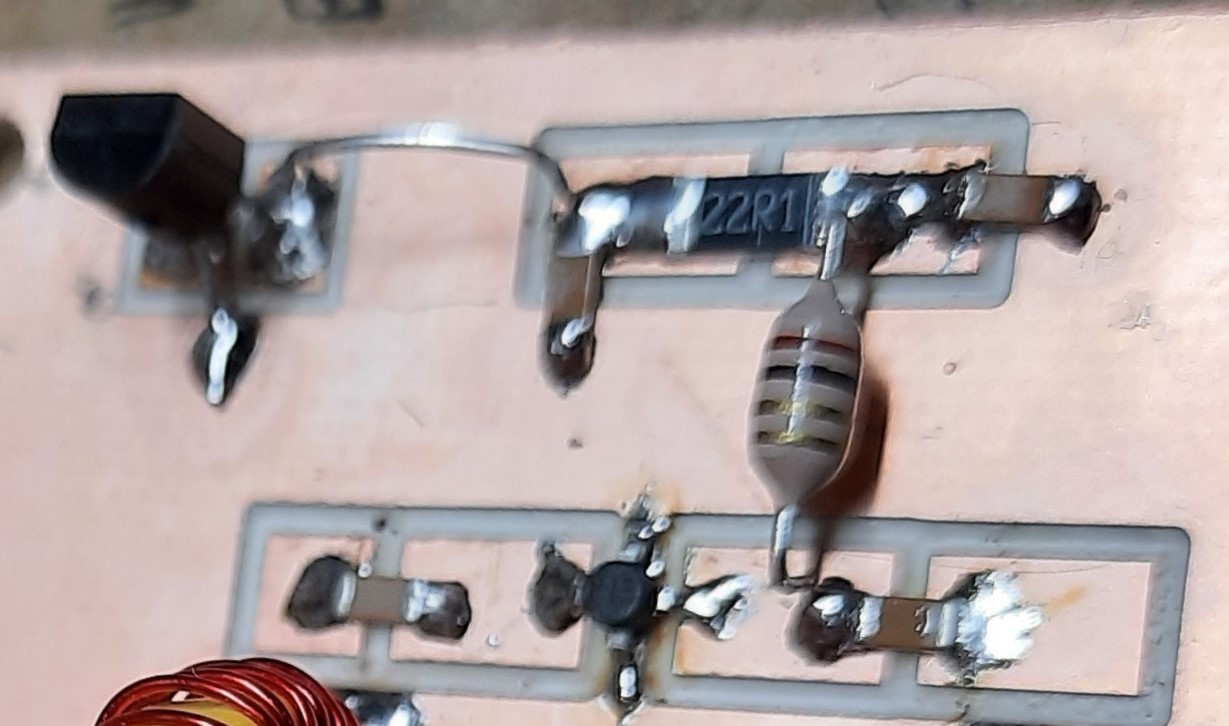
The board itself has a steerable module (2 Relays), an ADE-1 (PD/BM), and SBL-1 (Rx/TX Mixer), the 4-pole 4.9512MHz Filter (SMD Caps backside) and two DGM's fashioned from pairs of J310's with a tuned tank, and an on-board BFO with two SMD 2N3904's. A couple of trim pots sets the stage gain (Gate #2) of the DGM's. There is input matching to the DGM's.

I have no recollection why this didn't work but am not seeing the Crystal Filter matching transformers. (Must have been liberated for another project.) Or the input match to the DGM's takes care of that issue since the cores are FT-37-43s.


If this were to be fixed for use (FFU) I would remove the BFO board and use the Arduino + Si5351. 

Today's post demonstrates that sometimes old non-working projects possibly can be resurrected and that I do have a Nano VNA useful in looking at filter pass bands plus knowing how to build crystal BFOs.  

While some would look at the plot as having low pass band ripple, I see a filter likely to show its shortcomings on a contest weekend on 20M and the need to have the LO above the filter frequency to take advantage of the LSB slope.

Check your junk box as you just may have a rig awaiting resurrection.

73's
Pete N6QW


Monday, March 25, 2024

March 25, 2024. MMIC Amplifiers

Yet another tool for your tool kit ~ The MMIC (Monolithic Microwave Integrated Circuit) Amplifier. The MMIC amplifiers are simply superb when looking for a module to add 20dB gain to a circuit, are termination insensitive, 50 Ohms in/out and low noise figure and good to 2GHz. 

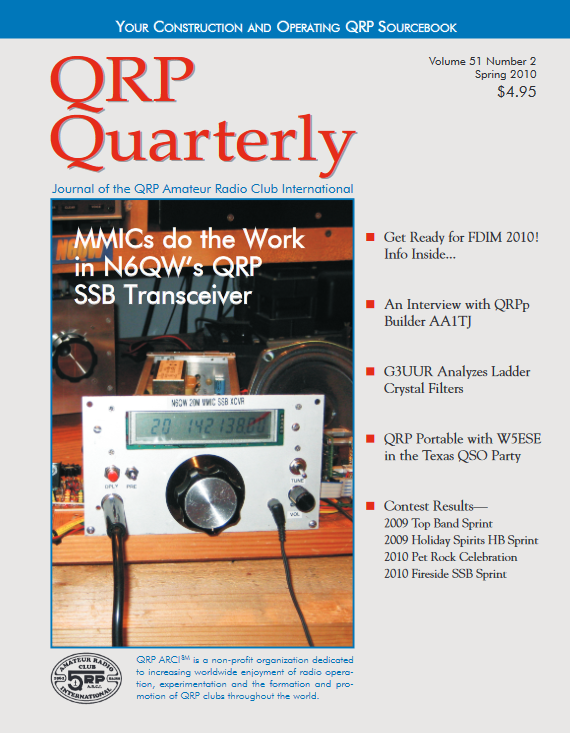
I first used MMIC amps in a bilateral 20M SSB Transceiver way back in 2010 and while it didn't make the cover of Rolling Stone it did make the cover of QRP Quarterly.


By far the biggest hurdle with using MMIC amplifiers is that they are surface mount and really small. They are incompatible with glue down Manhattan pads, Fat Fingers and require steady hands. Careful circuit layout is also a must!


12 Sq In. and 50% of a SSB Transceiver, A steered module with IF, PD/BM, Rx/Tx Mixer


My AG393-86G MMIC Amplifier


The devices you see above are Tri-Quint AG303-86G's which are now obsolete. BUT Mini-Circuits sells the MAR-6SM+ which is DC to 2GHz, with 20dB gain and a 2.3 dB Noise Figure with an application circuit shown below. For less than $20 you can buy 10 units at Digi-Key.

The MAR-6SM+ operates with 3.5 VDC but the table shows the dropping resistor needed for various voltages. The Mini-Circuit devices draw about 16ma. I used a 1uH choke with the Tri-Quint devices and the caps are 20nF. The supply voltage on my application was 5VDC.


Aside from that 1st project in 2011 I have used MMIC devices in several SSB Transceivers especially where space and performance were a concern.

MMIC's are for the more advanced homebrewer since they are SMD and are way beyond the Ugly or Manhattan style of construction. But then again, their specifications and SMD size suggest a perfect balance for a minimalist yet feature packed radio. 

The MMIC 20M SSB on the Cover of QRP Quarterly!


Yet another tool for your kit.

73's 
Pete N6QW

PS I have been collecting some important topic data. It appears the blog readers are focused on simple project style posts and bypass anything Raspberry Pi or digital communications modes. I got the message!


Sunday, March 24, 2024

March 24, 2024. The Medium is the Message

A bit of magic is always a good place to start. With magic, coins appear from nowhere or perhaps with a bit of magic you can make your mother-in-law disappear. Or perhaps a new radio appears on your operating table with no idea how it got there. But as with all magic what appears to be likely is just an illusion.

Yes, your mother-in-law disappearing was just a dream, and she is still there always telling you her daughter could have married a lawyer or doctor.

For instance -- how did this radio get inside a Champagne bottle? Yes, it is a fully functional 40M SSB Transceiver!


Or maybe more fundamentally how with but a few hundred milliwatts of power long distance communication is possible? 
 
In the 1970's Marshall McCluhan offered a simple paradigm that the Medium is the Message and a template for the Orange Guy for his political purposes.

But our medium is ham radio and the tied at the hip connection to technology. Our message is that you have to know stuff to be a ham. For instance, you have to know where the "ON" button is for your $5K FLEX Radio and how to find the best deal on a new appliance box. Or better still how to leverage you credit card, so those purchases of expensive offshore rice boxes give you the most cash back. Yes indeed, you do know stuff!

But we really use a technically oriented medium in the conduct of our hobby and so doesn't it make sense that all hams should have some modicum of technical ability other than just contesting or operating.

73's
Pete N6QW

PS The bottle is made out of Lexan Plastic and the bottom comes off!

Saturday, March 23, 2024

March 23, 2024. For Less than $20 You can have a ham rig!

 The $20 Radio Transceiver


This is where you must be skeptical and say Too Good To Be True! Likely it is. 

True out here on the left coast that $20 translates into about 3.5 Gallons of Gas and thus not incidental. Perhaps a slightly different metric, One Big Mac Meal with water.

The subject today is metrics and how they relate to our hobby. But first a personal story about unusual metrics. 

In 1984, I was working for McDonnell Douglas and assigned responsibilities as Program Manager to transition the Hughes Helicopters physical plant from Culver City to Mesa, Arizona and to build the new facilities to house all of the manufacturing and administrative operations. 

Routinely I would brief Jack Real the then President of Hughes Helicopters on the project progress. Follow the link to read about an aviation pioneer. 

At my 1st briefing where we discussed buildings sized at 300,000 square feet, he stopped me and asked that when I did future briefings that I convert the building sizes into Jack Real Homes. He gave me the square footage of his home and we would then make the conversion. My staff just didn't understand that Jack Real was a true engineer and was sizing things in a metric that could be understood by him. 

Other notable points -- he always referred to Howard Hughes as Mr. Hughes and offered that those who really knew Howard Hughes never called him Howard. In case you are wondering yes, the Culver City plant did indeed have an apartment where Howard Hughes would stash his girlfriend's. 

So, to our metrics. Critically we are always interested in power like how much power output and how much power input and often we see the term dBm. That is a measure that relates the power gain as referenced to 1 milliwatt. If you see a rating of 30dBm that is a 1-watt (1000 milliwatts) signal as compared to 1 milliwatt. 10*log(1000/1) = 30dBm. The 1 watt is expressed as milliwatts. Think back to Jack Real and his house size -- same idea.

Easily enough if you had only 0.5 watts that is 1/2 the power or 3dB down and this its value is 27dBm. If you had 2 watts then that is + 3dB or 33dBm. Five watts is 37dBm. Lest we forget 1 milliwatt output is 0dBm. 

You can have negative values of dBm and that occurs for powers less than 1 milliwatt. For instance, if you are seeing 1/10 of a milliwatt that is -10dBm and 1/100 of a milli-watt is -20dBm. 

If your ADE-1 DBM calls for no more than 7dBM of LO Drive, then that my friend means no more than 1.414 Volts PTP. The math: 1.414 Volts PTP into a 50 Ohm load is 5 milliwatts. That equates to 7dBm where 10*log(5/1) = 7dBm. If you pump 2 Volts PTP into the ADE-1 that is 10 milliwatts or 10dBM a 3dB increase in power a +3dBm.

So, whether it is Jack Real houses or dBm it is important we understand the reference basis when using our metrics. Alas 1KW is nothing more than a 60dBm signal. That sounds so puny when referenced to dBm.

PS. The Home of the Apache Helicopter is Mesa, Arizona. 

73's
Pete

Friday, March 22, 2024

March 22, 2024. Technology at our doorstep.

It is hard to keep up with the new technology hitting the market and what it can do for our hobby. Regrettably no time at the N6QW Laboratories to really explore all the possibilities but here is one that looks like it can be something useful in the shack.

Over 15 years ago the Raspberry Pi hit the market and at that time was advertised as the full computer the size of a credit card and costing about $35. We are now on the Raspberry Pi5 -- but the $35 price point is significantly higher.

On the other end currently available is a Raspberry Pi Zero W which is half the size of the original R Pi and less than $35 in today's dollars. Grossly speaking the Pi Zero has a faster processor than the original but somewhat limited in the on-board RAM and more like the original R Pi. By the way the Pi Zero W is a wireless version so affords internet connectivity.


One of the very 1st projects I saw using the original R Pi was a beer dispenser that checked your ID before it would dispense the brew. Undoubtedly that Beer Dispenser DIYer was a ham.

But the Pi Zero W has some possibilities for our hobby like remote control of an Antenna Tuner or a Digital SWR Bridge. How about the guts of an I/Q SDR transceiver? A DDC SDR might be more of a challenge.  One current you tube video shows the Pi Zero W displaying You Tube Videos on a 40-year-old Commodore computer.

But there are always issues and the Pi Zero W has limited I/O capabilities and so you would need to tack a powered USB Hub on that jewel which now makes it physically larger. The other problem to fully explore its capabilities is the software availability for specific projects. Thus, you likely would have to learn Python or Micro-python to get the full bang from your buck. 

So OK time to retreat back to your comfort zone and I didn't even mention using the Pi Zero W to control the slug in your Glue Stick Analog PTO. It could count the turns and give you a readout of the turns and a conversion matrix of turns versus frequency. There are very small stepper motors that could easily interface the Pi Zero W with the Glue Stick. Oh well, too hard.


73's
Pete N6QW


In case you are keeping score...

 Interesting results... Iowa : Joni Ernst's Republican seat was won by Democrat Josh Turek. [senatordb.com] , [ballotpedia.org] Kansas :...