Saturday, September 21, 2024

Sept 21, 2024. More Homebrew SSB Radios

 Today I want to pass gas about one of my homebrew transceivers. This specific radio was built to essentially replicate a radio built about 20 years ago, where the earlier 20M version was 4X4X8 and had an LCD display.

A ham who had seen this earlier rig lost his job and essentially sold all of his ham equipment to feed his family. I sent him the rig so he could still get on the air. Thus, the desire to replace the rig but put it on 40M.


This radio is a bit bigger than the original and of course has the color TFT display and two VFO's with memory. The 2nd VFO boots up on the 40M FT-8 frequency and has three sets of J310's wired as a Dual Gate MOSFET and all have trimmer pots to optimize their gain. 

The rig is built on two boards with the upper board having the IRF510. For a heat sink I used a thick aluminum plate that is bolted to the underside of the top board. This second unit has a compact look and would work pretty well for a POTA or SOTA event running at 5 watts.

Needless to say, it indeed would be a Chick Magnet! Some early photos during construction.


The Color TFT has undergone several iterations, and the current one has a black background to enhance readability.

This is a good example of what can be done when you know stuff. You can know stuff by doing stuff, making mistakes and learning from the whole process.

TYGNYBNT. Don't eat your pet!

73's
Pete N6QW


Friday, September 20, 2024

Sept 20, 2024. The Motorola Lapdock. (I did not misspell Lapdog.)


Motorola in a stroke of genius took a Smart Phone and by plugging it into an accessory device called a Lapdock turned the Smart Phone into a laptop computer. This made the Smart Phone work like a home computer.

The Smart Phone (Motorola of course) is plugged into a docking mechanism and there you sit with a keyboard, mouse, built in speakers and screen ready to watch Tik Tok shorts or hear the latest on cat eating immigrants.


The practicality of the Lapdock goes beyond a Smart Phone in that with adapter cables (Micro HDMI and Micro USB) any computer can plug into the Lapdock. This works perfect with a Raspberry Pi4 or Pi5 and think ahead to POTA and SOTA events as it does have an internal battery.

While the lapdock is no longer a standard product, many pre-owned (used) units can be found on eBay.

One advantage of the Lapdock is space conservation and the bonus roll up of keyboard, mouse, display and speakers into a small package. This screams portable operation with a Raspberry Pi4 or Pi5 which is on par with the original Smart Phone but on Steroids. I say this in that the user has more control of what is installed on and done with the Pi4 or Pi5.

This is another case of using some almost last gen technology to operate with our rigs. This also opens the door for use with my homebrew SDR transceiver and keeps it a compact package. Here is an old N6QW video of the Lapdock with the RPi2 running a Soft Rock transceiver.


Today I hope I opened the door to the possibilities that exist to us as hams, and we only need to open our minds to those possibilities.

To keep things in perspective, the Hermes Lite 2 and SS Amp are on a network and located 100 feet away (connected by CAT 6 cable) from the Lapdock/Computer. Think of those possibilities.

TYGNYBNT. Don't eat your pets!

73's
Pete N6QW

Thursday, September 19, 2024

Sept 19, 2024, Craftsmanship, Creativity and Cool!

Today I wanted to share a homebrewer's work that hits the "Triple Crown" Triple C (Craftsmanship, Creativity and Cool) mark. We are talking about Mike, KG7TR

Mike's website says it all -- Homebrew SSB Radios. But there are many homebrewers who claim that about their websites, but KG7TR's work is with vacuum tubes.


Combo Transmitter and Receiver using Octal Tubes


Mike's front panels are something not often seen with homebrew radios including solid state -- but just think behind that panel is a whole array of shack warming vacuum tubes.


The rig below looks like a military radio -- how cool is that?


KG7TR has replicated some work of the past like Anthony Vitale's W2EWL seminal converted ARC-5 phasing transmitter.


This transceiver below uses the famous McCoy 9 MHz Crystal Filter for LSB on 75M, all built into a Tektronix Scope case.


The "wow' factor about Mike's work is how amazing the finished work shows. All of his work has the form, fit and finish of something coming off a Collins production line.  The other aspect is certainly a one of a kind in that all are tube radios and, in some cases, all octal tubes. 


A Tip of the Cap to KG7TR.

I can just imagine a QSO with KG7TR where he says the rig on this end is a homebrew vacuum tube transceiver.

Visit his site and just marvel at KG7TR's work and be envious that you likely could not match his skill set. I am one who is more than just slightly envious. 

TYGNYBNT. Don't eat your pet.

73's
Pete N6QW

Wednesday, September 18, 2024

Sept 18, 2024. A failure to communicate! Receiver Gain Distribution.

A Failure To Communicate! Those ominous 4 words have appeared in reports such as the 9/11 Commission Report, or in describing 20M Band Conditions and then extending even to an equipment breakd0wn. In short, these issues are the causal factors of a failure to communicate and not so much inside the communications itself.

The inside the communications factor can be seen in the current political environment where it is suggested that immigrants are eating your pets. It is clear the pet eating comments are to grab the headlines and not so much to identify any problem. The solution to that is November 5th.

I also believe those 4 words were used in a Paul Newman movie ~ Cool Hand Luke. 

There is yet another aspect in the assumptions we individually make and then ask for something based on a not so clear assumed condition. I received another email last week that simply said send me the code.  I wrote back that unless the person identified the specific project I was at a loss as to what to send as it was a failure to communicate. I have not heard back. 

Without making an issue, the several requests for send me the unidentified code came from offshore where English is not the primary language. So that may be a factor but that is not an excuse!

The new phrase might be: If You Want Stuff You Have To Know Stuff. The knowing may be as simple as identifying specifically what you want. 


Rated #1 on Sherwood Engineering's list


This raises a question (back on to the Techie Stuff). The question of the day involves gain distribution in a homebrew receiver and where should the gain stages be applied. This borders on how big is big? 

But as we well know everyone wants a specific number if only to argue -- that is too big or too small. For the one or two sharp shooters in the blog readers set, your ears should perk up as you ready an argumentative response. 

There are neat terms like MDS (minimum discernable signal) where you can quantify that a particular topology can copy a weak signal with the weakest identified as MDS. 

Too much gain at certain parts of the signal train can cause a lot of noise to be amplified and carried along with the signal. This is especially true in front end RF Amplifier stages. Several commercial designs simply have no RF amplifier stages. This tends to work well below 20M but when you get beyond 17M -- the receiver almost sounds like it is on life support. No Noise BUT No Signals.

So, by picking a reasonable level of RF amplification walks the thin line of boosting the incoming signal without overly boosting the noise. A gain of say 5 to 10dB for the RF Amp would be a starting place. 

But external noise is not the only noise as there is noise internally generated within the receiver itself. This drives what you use and how you use it. Running stages Class A would likely result in a different outcome than from those running in other classes of operation.

Analog Devices has an exhaustive paper on noise in a receiver and can be seen here

Intermediate stage gain must consider that you want to assure you are not hitting the Crystal Filter with a sledgehammer. W7ZOI has often used a Pad after the post mixer amplifier so you are not really banging the crystal filter with signal. It also helps if you limit the bandwidth of the signals being applied to the filter especially those coming from the Balanced Modulator in a transmitter configuration.

A chance to make up for signal deficit lies with the audio amp stage. Not any old stage like a LM386, but a well-designed stage that delivers a significant amount of stage gain without a lot of noise in the side car is the goal. A homebrew audio amp using multiple gain stages is certainly a choice. 

So, what is a number for overall stage gain? Such a number is a trap unless you also consider a clean sound coming out of the speaker. To hedge my answer the overall stage gain should be that required to copy weak signals while minimizing internal and external noise at the band of operation. Old wives' tales often suggested 100dB.

TYGNYBNT. Don't eat your pet.

73's
Pete N6QW

Tuesday, September 17, 2024

Sept 17. 2024. Additional Homebrew Considerations

 My time is limited and so not much new homebrewing ongoing. But I have been cycling through projects of old and suddenly it's clear that I should have paid more attention to possible "refinements". 

Most critical when I first started building SSB Transceivers was the frequency stability and accuracy and as important the signal quality on both transmit and receive. 

Homebrew dials fitted to 6:1 Jackson Bros. vernier drives were the Arduino/Si5351 of the early days. Placing the BFO / Carrier Oscillator at the right place on the slope of the filter was indeed a bit of black magic. Early rigs were vacuum tubes with solid state LC VFO's. In more recent times this has all given way to solid-state, amazing Color TFT displays and the Si5351. Even beyond that is now SDR. 

Most of my rigs in the garage storage tubs have the basic stability and signal quality features but   it appears I stopped there. Without much change to the existing hardware, many refinements could have been or could be added to these rigs.

These upscale mods include working S Meters, Voltage Monitoring, SWR Meters, CW Keyers and Automatic Identification. Some are on wooden planks and should have been put in proper cases. 

A huge shortcoming is the lack of labeling and identification so when you pop the lid -- you have a better idea of what was done in the past. One ham I heard of glues the schematic onto the inside of the enclosure. 

One positive thing I have done is to adopt a wiring standard where any wiring used on receive only is Orange and any wire used only on transmit is Yellow. This is a huge leverage factor when trouble shooting!

Another small but important consideration is hardware. I typically use what I have and for a single project probably OK. But it can come back and bite you. The antenna connector on my projects could be an RCA, BNC or SO-239. I should have opted for a standard.

The issue is that now I need a box of connector adapters when I try out various rigs. Several of those bargain adapters from China are flaky and subject to intermittent operation. I was shocked to find out that the better-quality adapters cost more than a Big Mac at Mickey D's. Now I attempt BNC only!

The import of today's message is to think about the refinements at the outset and include those in the scope of work. Doing this in the initial planning enables the add on later on without literally having to rebuild the whole rig

Now for the requisite photo to attract blog viewers.


This particular radio has extra panel space to accommodate a larger display. This now would give more real estate to provide status on SWR, Voltage levels etc. The Arduino has the headroom for this and I have larger displays in the bins. This would not be a large project time wise. BTW this box has had three different rigs installed inside. Recycling!

TYGNYBNT. Don't eat your pet!
73's
Pete N6QW


Monday, September 16, 2024

Sept 16, 2024. How a Real Radio should look like!


The PENNTEK TR-45L CW Transceiver

The PENNTEK TR-45L radio (made in Pennsylvania) screams volumes with an old school analog panel meter alongside a 16X2 LCD. Imagine this jewel sitting on a picnic bench while you send CQ POTA. It is a chick magnet extraordinaire! [A suggested upgrade: A Juliano Blue LCD.]

This is not unlike the time in 1967 while living at 350 Union Street in San Franscisco, where a movie was being made using our parking garage. The movie was Hospital featuring George C Scott and Julie Christie. In 1967 Christie was 27 years old.

It was early morning, and I had a street facing large window slightly above ground level. I opened my drapes while still in my Navy issued skivvies, (having just finished my 4-year obligation) and there was Julie Christie no more than 10 feet from me. It was the same feeling some 60 years later seeing the TR-45L.

Before getting way off on the deep end, the fully fitted TR-45 is about $750 and at the skinny end (stripped down version) about $200 less. I guess a somewhat premium price for a 4 Band 5-Watt CW transceiver. 

A superb looking transceiver!


Today at 84, Julie Christie loses out in the looks department as compared to the TR-45! But in 1967, a really different story!

Quite frankly, I would be hard pressed to justify spending $750 for a rig like this. But given all of its features and small volume production that cost is likely justified. But due to my other obligations simply not on the Santa wish list. However undeniably it does have the look of a high-class hooker!  

Moving from the High-End Honey's to the Bargain Basement Broad's are some offerings from the 4 State QRP Group


Hilltopper 20 Designed by Dave Benson K1SWL

This kit was designed by Dave Benson of Small Wonder Labs (K1SWL). The price is more in line with my budget gag level, about $125, and available from the 4 States QRP Group. 

Indeed, there is some interesting hardware around us but that also suggests that any ham worth his salt could homebrew a CW rig. One of K1SWL's 1st kits was the NE4020 which I totally homebrewed. Your homebrew offering might not look like the TR-45L or a 1960's Julie Christie but certainly would put Fire in the Wire.

TYGNYBNT. Don't eat your pets!

73's
Pete N6QW

Sunday, September 15, 2024

Sept 15, 2024. Homebrew from ZL2 and LA3 Land

If you haven't caught on as yet -- there is a ton of homebrew projects being developed from VK/ZL land. Want proof of that statement, just visit VK3YE's You Tube Channel.

A site worth visiting is from ZL2PD. There are many projects on his site which range from test gear to complete radios.


The above is an example from his website. This sure lets you see what is going on between the rig and the antenna. Bravo.

 I also suggest getting a membership with the G-QRP Club and  receive the quarterly SPRAT publication which is chock full of useful radios/test gear. A hallmark of this publication is that what is presented is typically not complex nor requires a home loan to undertake. Issue 200 is soon to be in the mailboxes.

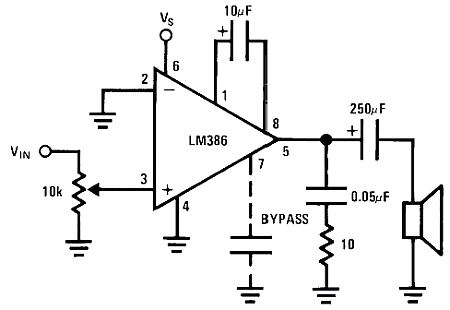
The ubiquitous and often cursed LM386 Audio Amp has been put under the microscope by LA3ZA. If you have ever done the homebrew mating dance, then most likely you have touched a LM386!


The internet is a vast resource to peek into shacks the world over and have a look see of what is on the bench. For many US homebrewer hams, regrettably they limited themselves to the work of W7ZOI, W1FB and W1ICP. (Hayward, DeMaw and McCoy). Certainly, these were tall pillars but there are many more homebrew resources now in the world.

We only need look with wide eyes to see the amazing stuff coming from Farhan and Hans Summers. But many highly talented homebrewers are unknown but yet have done significant work to enrich our shacks and give us new toys on the bench.


If you are a US blog reader and are not registered to vote but eligible to do so -- git er done! 

TYGNYBNT. Don't eat your pet!

73's
Pete N6QW

The Risk of Power.

 What happens when the faithful lose faith? We don't know the result but now it is time to pop more popcorn as the interesting part of t...